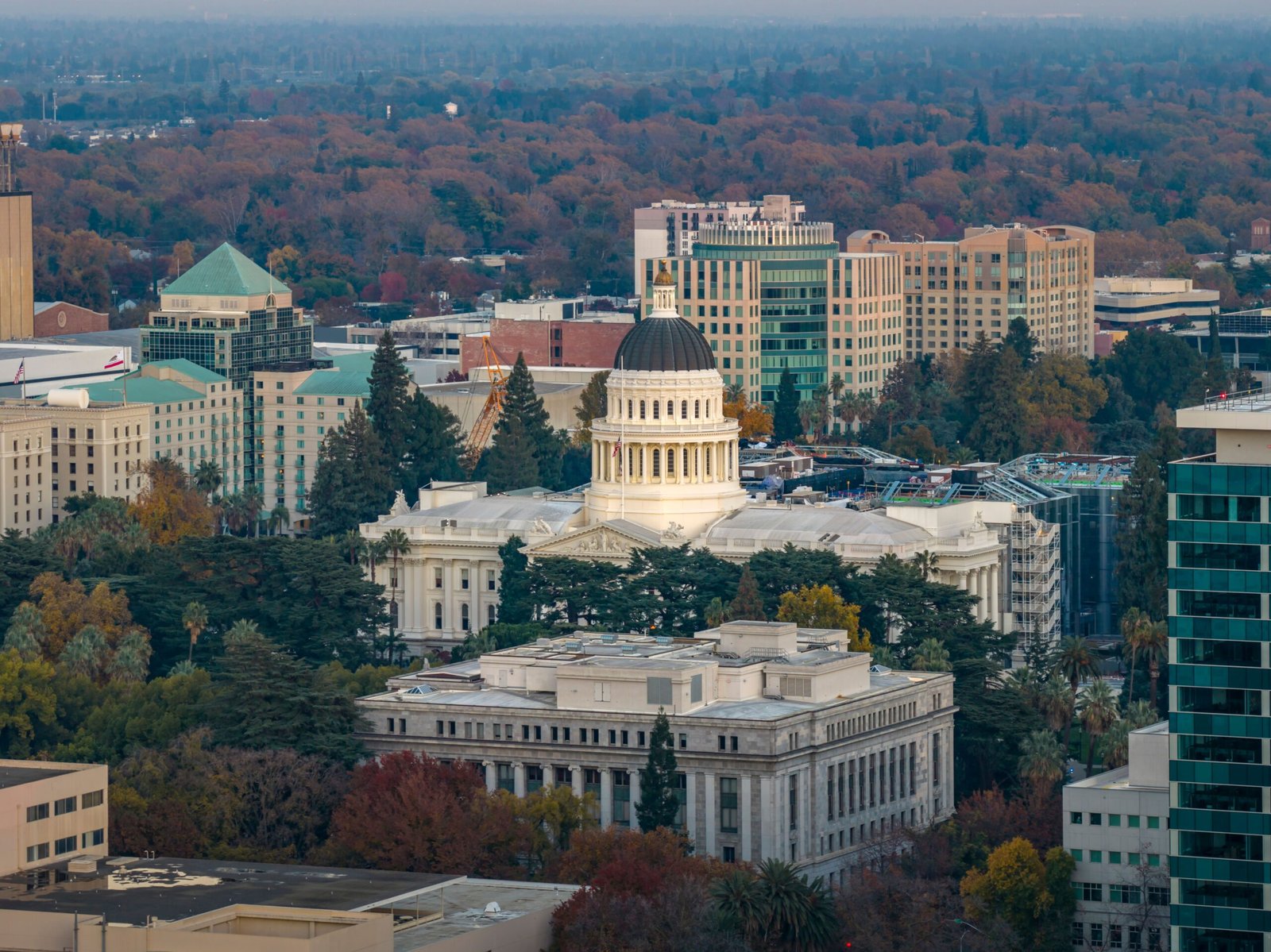
If you ask someone to name the capital of New York, Illinois, or California, many people instinctively guess New York City, Chicago, or Los Angeles. In reality, none of those global metropolises serve as their state’s seat of government. Across the United States, 33 out of 50 state capitals are not the largest city in their respective states. In several cases, the capital is a quiet, mid-sized town with a fraction of the population of the state’s commercial powerhouse.
Why States Avoided Placing Capitals in Major Metropolises
The pattern of separating political power from commercial dominance was rarely an accident. During the late 18th and 19th centuries, state legislatures intentionally moved capitals away from major coastal ports and industrial hubs for four recurring reasons.
1. Geographic Centrality Before Modern Transportation
In the era of horse-drawn carriages, stagecoaches, and early railroads, lawmakers needed a capital located near the geographic center of the state so representatives from rural counties could reach legislative sessions without spending weeks on the road.
- New York moved its capital from New York City up the Hudson River to Albany in 1797 so upstate and western lawmakers had reasonable access.
- Pennsylvania shifted its capital inland from Philadelphia—then the largest city in North America—first to Lancaster in 1799 and permanently to Harrisburg in 1812.
- Ohio bypassed Cincinnati and Cleveland to design Columbus from scratch in 1812 specifically because it sat near the exact geographic center of the state.
2. Limiting Urban Political Influence
Early American lawmakers worried that housing the state legislature inside a massive port city would allow wealthy merchants, bankers, and urban crowds to exert undue pressure on state policy. Placing the capitol building in a smaller, neutral town created a buffer between commercial monopolies and legislative decision-making. This philosophy directly mirrored the creation of Washington, D.C. as a separate federal district independent of New York or Philadelphia.
3. Compromises Between Rival Cities
When two booming cities competed fiercely for the economic prestige of hosting state government, legislatures frequently settled the dispute by selecting a smaller third city located between them.
- Missouri bypassed both St. Louis and Kansas City to establish Jefferson City along the Missouri River in the center of the state.
- Florida compromised between St. Augustine (the Spanish colonial center in the east) and Pensacola (the major port in the west) by building Tallahassee halfway between them in 1824.
- South Dakota selected Pierre in the central Missouri River valley to balance competing interests between Sioux Falls in the east and Rapid City in the west.
4. Military Security and Wartime Vulnerability
During the Revolutionary War and the War of 1812, coastal capitals proved dangerously vulnerable to naval blockades and invasion. Moving state archives and treasuries inland protected state governments from sudden coastal attacks—a major factor in relocating Virginia’s capital from Williamsburg to Richmond and North Carolina’s capital from New Bern to Raleigh.
The Most Dramatic Population Gaps Between Capitals and Largest Cities
In several states, the size difference between the political capital and the largest economic hub is striking:
- New York: New York City has over 8.3 million residents, while Albany has roughly 101,000.
- Illinois: Chicago is home to roughly 2.7 million people, compared to Springfield’s population of around 114,000.
- Vermont: Burlington is Vermont’s largest city (~45,000 residents), while Montpelier is the smallest state capital in America with just over 8,000 residents—and the only U.S. capital without a McDonald’s.
- Missouri: Kansas City (~510,000) and St. Louis (~280,000) dwarf Jefferson City (~43,000).
- California: Los Angeles (~3.8 million) and San Diego (~1.38 million) far outsize Sacramento (~526,000), which became the permanent capital in 1854 during the California Gold Rush.
The 17 States Where the Capital Is Also the Largest City
Only 17 states concentrate both their largest population center and their state capitol in the same municipality. These include Arizona (Phoenix), Colorado (Denver), Georgia (Atlanta), Hawaii (Honolulu), Idaho (Boise), Indiana (Indianapolis), Iowa (Des Moines), Massachusetts (Boston), Minnesota (St. Paul/Twin Cities metro anchor, though Minneapolis is technically larger by city limits—making it 17 total when counting city-proper leaders like Oklahoma City, Salt Lake City, Cheyenne, Little Rock, Charleston, Jackson, Providence, and Nashville).
By separating civic administration from commercial centers, most American states created dual-engine economies: major metros drive private-sector trade and finance, while smaller capital cities maintain stable, year-round employment anchored by state agencies, universities, and public institutions.